I’m a Scratch Golfer with a 15-Handicap Putter. My First Quiet Eye Test
My last three months: −3.3 SG putting per round. A quiet eye routine led to +1.5 SG on nine holes—but one hot stretch is not proof.
By Jacob Göransson · A personal experiment, not a proven fix
I’m a scratch golfer, but my putting is playing like a 15 handicap. I tried a “quiet eye” routine—and my first nine-hole test was the best putting stretch I’ve had all year.
I track every shot, so I know where my game is. Over the last three months, driving, approach and around the green have been strengths relative to my handicap group. Putting is a different story: −3.3 strokes gained per round against the PGA Tour baseline, which StrokesGain translates to an estimated putting handicap of 15.2.
Slightly better than scratch tee to green. A 15-handicap putter on the greens. Frustrating.
The starting point: 16 rounds, one obvious weakness
This is my last three months of tracked rounds, before judging whether quiet eye makes a lasting difference:
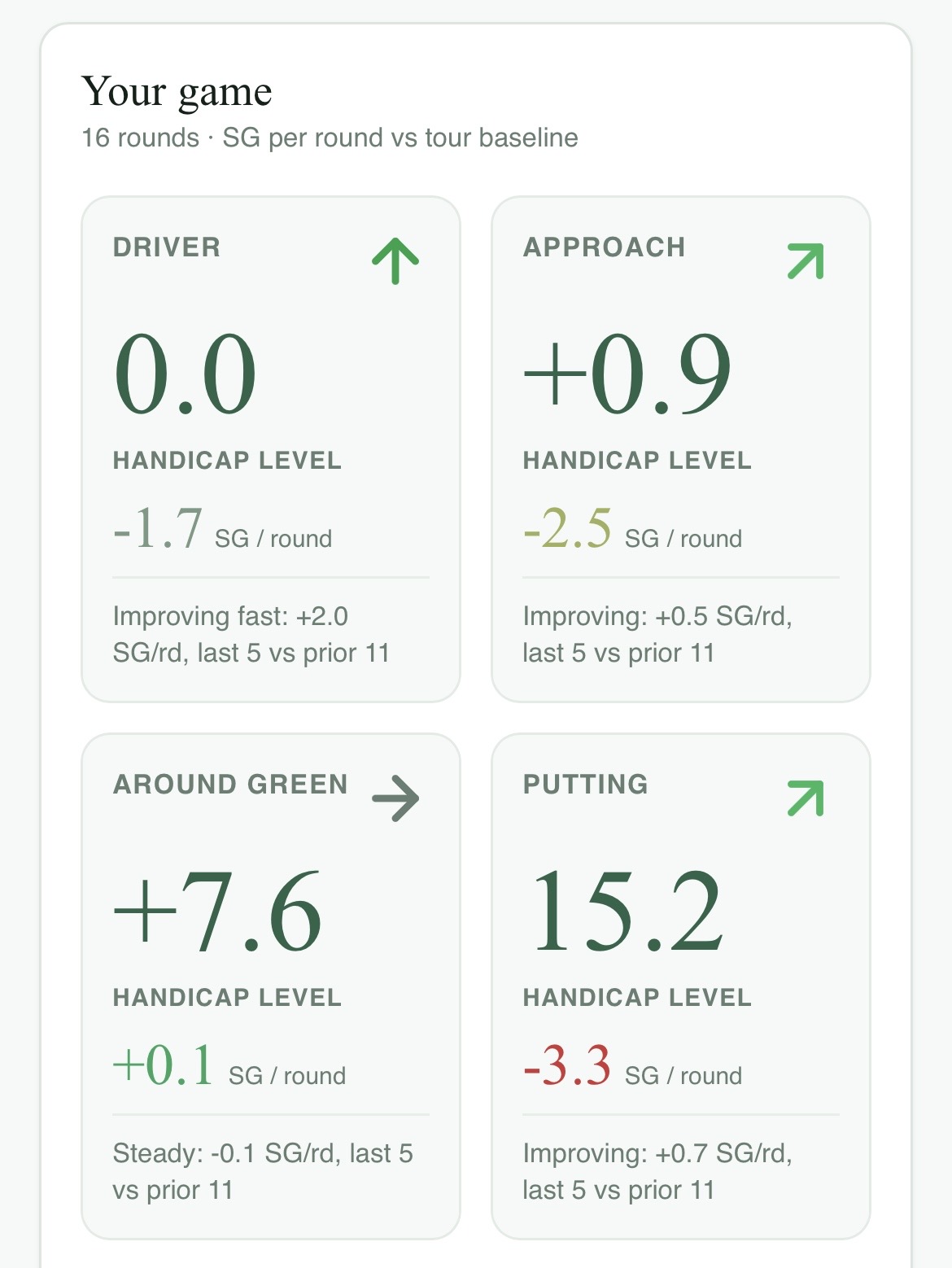
The screenshot’s SG figures are versus the PGA Tour baseline, not versus scratch golfers. A negative number does not automatically mean poor play for an amateur: my driving and approach can lose strokes to Tour players while still being strengths for my handicap. The large handicap figures are estimates for each area of the game—not separate official handicap indexes. In golf notation, a plus handicap is better than scratch.
For the calculation behind those numbers, see strokes gained putting explained or the handicap and strokes gained converter.
What a bad putting day looked like
The average was frustrating enough. One of my worst putting rounds was much worse: −7.6 SG putting, with an estimated putting handicap of 44.4 for that single performance.
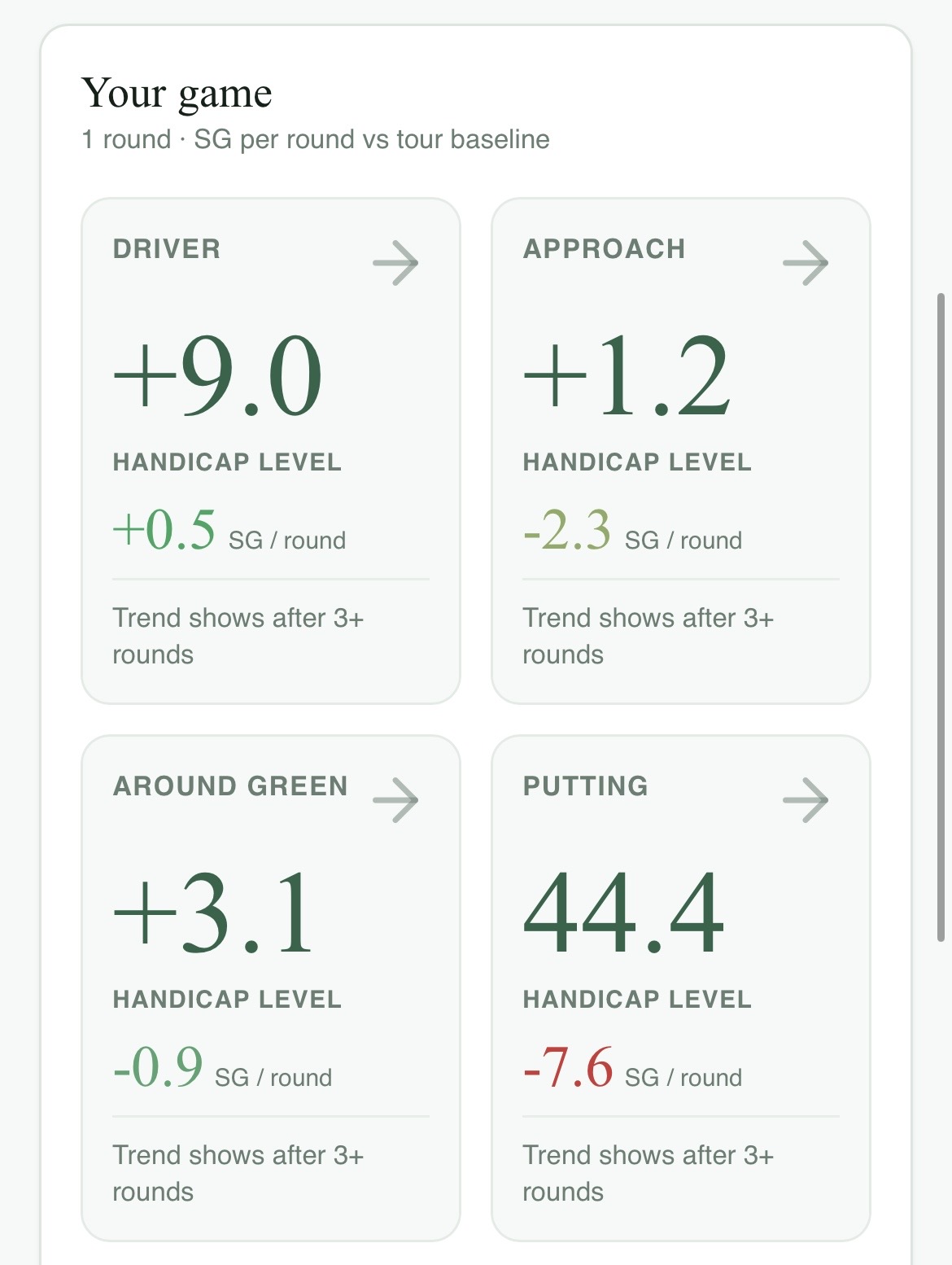
This is why I look at several rounds rather than letting one day define my game. But it also explains why I was willing to try something that did not involve rebuilding my stroke.
What is quiet eye putting?
I recently found the quiet eye research. In putting, “quiet eye” refers to the final steady fixation on the ball before the stroke, continuing as the movement unfolds. Instead of letting your eyes dart between the ball, putter and target, you settle your gaze on one small spot.
My practical version is simple:
- Read the putt and choose the line as usual.
- At address, pick a small spot on the back of the ball.
- Hold my eyes still on it for about 2–3 seconds before starting the stroke.
- Keep looking at that spot through the stroke, without immediately peeking at the hole.
That is the routine I am testing, not an exact laboratory protocol. No deliberate change to grip, setup or stroke for the first trial—just a different use of my eyes.
Before this, my eyes were moving around constantly. Especially on short putts, where I was nervous because I knew how much they were costing me.
What the research actually says
A review by Joan Vickers on quiet eye in golf putting describes longer quiet eye durations in highly skilled golfers: around 2.5–3 seconds, compared with roughly 1–1.5 seconds in less-skilled golfers. Those are durations of the fixation around the stroke—not a rule that everybody must wait exactly three seconds before moving the putter.
In a 2011 study by Vine, Moore and Wilson, quiet-eye-trained golfers recorded 1.9 fewer putts per round over ten competitive rounds. The study involved skilled golfers and also tested putting under pressure, where the trained group maintained its quiet eye better than the control group.
That is encouraging, but it is not a promise of two strokes saved for everyone. Putts per round is not strokes gained putting: it also depends on how many greens you hit and the distances you leave yourself. And a research finding in a particular group does not prove that my own nine-hole result was caused by the routine.
My first try: five under, +1.5 SG putting on the back nine
On my first try, I shot five under par on the back nine, with +1.5 SG putting over those nine holes. It was the best putting stretch I have had this year.
To be clear, +1.5 is the total for those nine holes. It is not an 18-hole average, and I am not doubling it and claiming that I am suddenly a +3 SG putter. The five-under score describes my whole game over that stretch—not five strokes gained from putting alone.
It felt great. But nine holes is nothing as evidence. It could simply have been a hot streak.
The biggest change was how calm it felt
Two things stood out.
First, I tended to pull the ball slightly left. I also know that I naturally aim a little left, so I am considering a setup that feels slightly open to see whether it is actually neutral. That is a personal hypothesis to test, not advice to copy: quiet eye does not diagnose an aim error, and I do not want to solve one problem by adding another compensation.
The bigger thing was the calmness. When all I had to do was look at one spot, my mind went blank instead of thoughts flying around over the ball. That alone might be most of the effect for me.
I cannot yet separate better visual focus, a simpler routine, greater confidence and ordinary putting variance. But the routine costs nothing, and it is not a swing change.
The next test: ten rounds, not a victory lap
I am going to run it for ten rounds and post the data. The 16-round screenshot above is the starting point; the next question is whether the putting improvement survives beyond one good nine.
I will keep tracking every putt and look at SG putting across the sample rather than cherry-picking the best day. If I also change my setup, that will be another variable—not evidence that quiet eye alone did the work.
I have previously written about testing aim, strike and other putting fundamentals. This is a new experiment, not a claim that a gaze routine replaces those fundamentals.
For now, the honest conclusion is small: I found a routine that felt calmer and coincided with my best putting stretch of the year. Whether it actually improves my normal putting is still an open question.
Have you tried quiet eye, or another routine for keeping your eyes still? I would be interested to hear whether it helped over time—or whether most players were already doing this naturally.
Based on my Reddit post and my own shot-by-shot StrokesGain records. To measure your own starting point, try the free strokes gained putting calculator.